




Homecoming 2026: which of these dresses can still be adjusted?
Two of these lace up the back, which means the fit is adjustable for the life of the dress. One has an open back with no closure to move. One has a bandeau bust that is fixed by construction. One ties at the neck, which adjusts the drape but not the body.
Nobody asks this question in the store and everybody asks it the week of the dance, usually at the point where the answer has stopped being useful.
How much can a homecoming dress be adjusted after you buy it?
It depends entirely on the closure. A lace up back adjusts across a range for the life of the dress. A zipper or a bandeau bust is fixed at one measurement and only a tailor changes it.
This matters more for homecoming than for almost any other dress, because the buying window is short and the wearer is fifteen. A gown ordered in early September for a dance in October is being fitted to a moving target, and the closure is what decides whether that is a problem.
Five styles follow, ordered from the most adjustable to the least.
What does a lace up back actually give you?
A fit range instead of a fit point. Lacing tightens or releases across several inches, so the dress works at the fitting and on the night without a tailor opening a seam in between.

A lace up back is the most forgiving closure on a fitted dress, and it is the reason this one can be ordered with a margin. Lacing tightens or releases across a range rather than sitting at one measurement, so the same dress works at the fitting, at the dance and at whatever point between the two the body decides to change.
It also changes the alteration math. Taking in a zipper dress means opening a seam and paying for the labor; a laced dress is adjusted by pulling on it. The beading here runs in a swirling pattern across satin jersey, which is worth noting for a different reason: heavily beaded seams are the ones a tailor charges most to move, so a dress that never needs the seam touched is worth something.
Stretch satin jersey. Crystal beading in a soft swirling design, delicate straps, fitted silhouette, lace up back. Black multi shown, three colorways offered. Sizes 0 to 12.

Same closure, different job. Here the lacing is not hidden at the back seam, it is the design, crossing an open back where there is no fabric behind it. That means the adjustment range is visible, and a dress laced tighter or looser reads differently from behind rather than just fitting differently.
Stretch tulle adds a second kind of give underneath that. A beaded stretch fabric moves with the body where satin jersey holds a line, so this one is adjustable twice over, once in the cloth and once in the lacing. The trade is that stretch hides a poor fit less well than structure does, which puts more weight on getting the lacing right rather than close enough.
Stretch tulle with beading throughout. Fitted silhouette, delicate straps, bold lace up open back, matching beaded choker. Fuchsia gold shown, second colorway offered. Sizes 0 to 12.
What if the back is open but not laced?
Then the stretch in the fabric and the size on the tag are the whole fit. It gives a cleaner line than lacing does, and it puts more weight on ordering the right size at the right time.

An open back with no lacing is a different proposition. There is nothing to tighten, so the fit comes from the stretch in the tulle and from the size on the tag, and the dress either works or goes to a tailor. That is not a flaw; it is a cleaner line than lacing gives, and a low back reads as a single uninterrupted shape rather than as a panel with cords across it.
What it does mean is that the ordering decision carries more weight. Size to the measurement taken closest to the date rather than the one from a month earlier, and ask what a side seam adjustment would cost before you commit, because the floral work along the hem and the liquid beading across the body both sit in places a tailor would rather not disturb.
Stretch tulle with shimmering liquid beading. Fitted silhouette, spaghetti straps, soft V neckline, floral embellishments along the hem, low open back. White multi shown, second colorway offered. Sizes 0 to 12.
Can a bandeau bust be adjusted at all?
Barely. A bandeau is cut and finished as one fixed piece, which is what creates its clean horizontal line. Altering it usually means disturbing whatever sits over it, so it has to fit on the day.
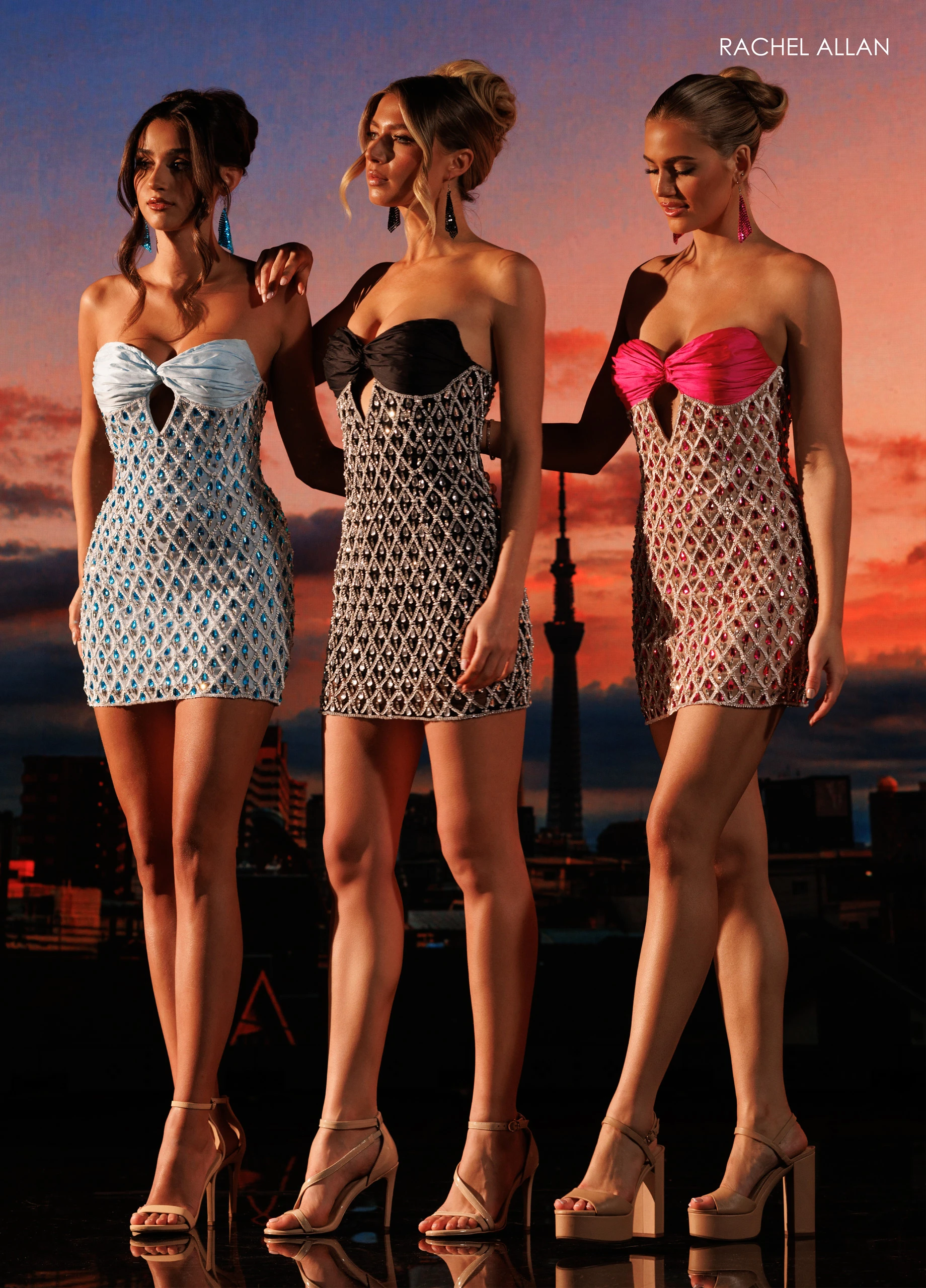
A bandeau bust is the least adjustable construction on this page, and that is a design decision rather than an oversight. The band is cut and finished as one piece, so it holds a fixed shape across the top of the dress, and that fixed shape is exactly what creates the clean horizontal line the beaded lattice hangs from below it.
So the fitting room test matters more here than anywhere else in this group. Structure that cannot move has to be right on the day you buy it, and the lattice overlay makes the bodice difficult to alter without disturbing the pattern. Look at what that lattice is doing over the nude lining. That layered construction is the whole effect, and it is the part an alteration would break.
Stretch tulle with a beaded lattice overlay and taffeta accents. Fitted silhouette, bandeau style bust, nude lining visible beneath the lattice. Light blue white shown, three colorways offered. Sizes 0 to 12.
Does a tie at the neck count as adjustable?
For coverage, yes. A halter tie sets how high the neckline sits and how deep an opening falls. It does not change the fit through the body, which comes from the cut or the ruching instead.

A tie at the neck adjusts something real, just not the part most people mean. It sets how high the halter sits and how deep the keyhole opens, so it controls coverage and drape rather than the fit through the body, which comes from the ruching instead.
That combination is quietly practical. Ruched chiffon has more tolerance than a smooth fitted panel because gathering absorbs a small difference in measurement without showing it, and the scarf ties long enough to leave a decision until the day. Tie it short for a neat line at the throat or long so it moves with the ruffle skirt. One dress, two different amounts of drama, decided in the mirror an hour before she leaves.
Chiffon. Softly ruched bodice with a keyhole detail, halter neckline finished with a flowing scarf tie, layered ruffle skirt. Navy shown, three colorways offered. Sizes 0 to 12.
Three things to ask before you leave the store, whichever of these she picks. What does an adjustment cost on this style, since a beaded seam and a plain seam are not the same job. How long does the shop need, because October books up in September. And can the dress be let out as well as taken in, which is the question that actually matters and the one nobody thinks to ask until it is too late to matter.
Find a Rachel Allan Retailer
All five are sold through independent specialty retailers who carry the collection and handle alterations themselves or work with someone who does. They can tell you what a given style allows before you order it rather than after.
Find the store nearest you and ask about the closure on the one she likes.


